Friday, March 27, 2009

Schindler's List


Schindler's List is a movie that is about a Nazi party member, Oskar Schindler, that owns a cookware factory and employs Jews that were forced into the ghettos or the concentration camps. He, at first, insists that he employs them because it is cheap labor. But soon, he befriends his accountant. But soon he gets word that his factory is a safe haven for people wanting to get out of the camps. Oskar comes off annoyed by this, but when he witnesses the Jews being forced out of their Krakow ghetto to go to the concentration camps he is saddened. Co-operating with his accountant, he ships Jews to his factory for them to work. In the end he orders an influx of Jews to work for his factory, only to make his factory a non-productive place. He bribes Nazi officials for months (to make sure they don't tell Nazi leaders that it's just a safe haven), until he goes bankrupt. The war ends, and he has to flee in order to not be held in captivity.

This movie means to me the human and inhumane side to people. I believe that one of the drives in the human psyche is the need to either feel dominant or submissive. I think Nazi Germany was built off of economic humiliation and the unfortunate miracle of everybody feeling submissive to a dominant figure. Schindler's notion on power is to be in the popular in order to save the minority. That way, he has a lower chance of being punished. Goethe accepts the bribe from Schindler, which implys that he is abusing his power (given from an unmoral system). Schindler does abuse his power, by going against party platform to buy Jews.

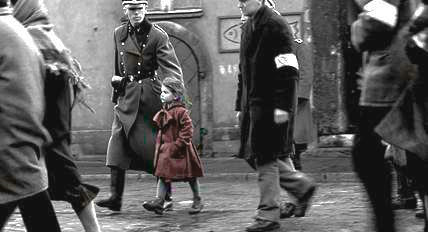
I thought this movie was vary effective because of the girl with the red jacket. This is a devise that makes the viewer remember a specific person. The crowds of people in the movie of Jews dehumanizes the crowd, making the lives of the Jews killed anonymous and apathetic. We see them as a group under discrimination from a political group as opposed to humans being killed. The girl in the red coat forces the viewer to sympathize and remember a girl (resembling innocence and defenselessness) caught in the cloud of Jews that seems unknown and distant.

Sunday, February 22, 2009

Pigments Sources

http://www.jcsparks.com/painted/pigment-chem.html
This website has a lot of information, especially on its artistic use and chemical properties. It covers various colors and their historical backgrounds.

http://www.eggtempera.org/index.php?a=eggtempera
This website is very historically oriented. Little info on chemical themes, but will serve a purpose.

http://reference.howstuffworks.com/pigment-encyclopedia.htm
Brief, but gives pigments in a nutshell.

http://www.lindapaul.com/about_egg_tempera.htm
Gives tempera painting in a context of art history.

http://wordnetweb.princeton.edu/perl/webwn?s=pigment
Has a clear definition of pigments.

http://davis.wpi.edu/~matt/courses/watercolor/properties.html
Tells about the basics of watercolor, which will be used to contrast with tempera paint.

http://www.ehow.com/how-does_4672330_water-coloring-work.html
How watercoloring works. Talks about binding mediums.

http://www.leadlawsuits.com/index.php?s=community
About lead in paint.

Tuesday, September 2, 2008

The Science Crisis in America

The federal government has stated that our students are not doing well in science so much to a point that "(America is) not producing the science excellence required for global economic leadership and homeland security in the 21st century. This is hard to digest, especially for me, an aspiring psychologist. The solution is to "ensure schools use research-based methods to teach science" and to achieve that school districts must team-up with universities to educate teachers on how to teach science. I keep hearing how schools must use "scientifically proven" methods of teaching, but yet the tests scores are still dangerously low. I think if the government just found some excellent methods and implemented them in schools on a federal level, this issue won't be as bad as it currently is. These statistics are not pleasing, with the average twelfth grader's knowledge of science being significantly behind other developed nations. The issue is being solved by telling and giving money to school districts to team up with the real-world of science and to help increase proficiency. But where school district "A" finds the good methods for teaching from school district "B" may put one at a disadvantage. I think this problem can be solved if teaching methods were nationally distributed.

The Questions I ponder:
1. What are the "scientifically proven" methods of teaching that the SDUSD has, and with what institutions?
2. Are my scientific skills up to par with other students in other developed nations?
3. What sciences are they measuring?

"The short answer? It depends."

(This article concerns the law right when it came out, this article is an excellent representation of how the law was greeted by educators and administrators.)
This news source specifically geared towards educators and school administrators takes a neutral side to the law, seeing its pros and cons. A spokesperson for a teachers' union does see how now a teacher is accountable for the performance of their students, but trying to make sure that a school can scape up the money and time to certify teachers to not get caught red-handed by the government is time-consuming. When it comes to the assessments for yearly improvement, there is a metaphor that it is similar to getting a a physical exam, a check-up to catch academic struggles sooner. Low test scores equal lowered federal funding, and to raise the scores better teaching strategies must be installed, which are "scientifically based". However, the strategies that are available are for teaching reading/phonics; math, science, and other subjects have no official sponsorship from the government. The tests scores can also very by demographics and environments, like how in rural areas, where there are less students in a school, as little as three or two can completely throw off the balance of the school's test scores.

Questions I ask myself:
1. How has this law been changed to close the loopholes and exceptions?
2. Are the "scientifically proven" methods still being added, and where can I find them?
3. Has the performance of students improved from the yearly assessments?

Friday, August 29, 2008

PBS Article

Based off of this article from PBS, I learned that the No Child Left Behind Act ("NCLB") was signed in January of 2002. A major reform on ninety percent of public schools was to take place. Those ninety percent are "Title One" funding, which means that they are schools that the students are living in poverty or have the potential of not doing well in school. It intends on saving these schools and students by implementing scientifically-proven methods of teaching, allowing parents to transfer their child to a school that has been labeled as unsafe or appalling in performance, the ability for government-entities to assign money to school programs, and making state liable for their students being proficient in their curriculum. States that don't do the latter will forfeit funding from the federal government. To moderate if these changes are being made, states will design a series of tests called "adequate yearly progress". These tests must improve every year to show progress.

After reading this article, I have some questions.
What is on the adequate yearly progress for California? Are students doing well on them? What kind of material is on the test? Just math, reading, and English?

Does this effect science, fine arts, and music programs?
If parents just switch their children to better schools, will the old schools crumble?